My History with Burnout
A white lock of hair, a book campaign, and the price I paid.
This post starts with an anecdote too. A story I was told as a child, though it wasn’t exactly a story for children.
My parents used to tell me about a man who, the day before his wedding, had gone into his burning house to save his belongings.
He never came back.
After the tragedy, overwhelmed by grief, his bride-to-be had what my parents called a "nervous breakdown".
At that age, I couldn’t fully grasp what it meant to lose the person you loved. What stuck with me was another detail, much smaller and much stranger.
According to my father, this woman with long straight hair had found herself with a long, frizzy lock, white as milk, in the space of a single night.
In my mind, that was what a nervous breakdown looked like.

A Thesis, an Internship, and a Wedding
Fast-forward to 2008.
The year my older sister got married. No offense to her, but I don’t remember the exact date. What I do remember is that it was about a week before my thesis discussion.
The written thesis had to be handed in on August 18, in Milan.
Let me repeat that: August 18.
In Milan.
For anyone unfamiliar with Milan, legend says that the city gets so empty in August, that you could walk around naked in public without worrying about being seen. I had a hell of a time finding a print shop that was open, and they only printed my copy as a personal favor. There was even a mistake in my name on the printed copy, but I decided that was perfectly fine. I couldn’t bring myself to ask them to fire everything up again just to reprint the cover.
With the document handed in, I still had about twenty days to finish the technical part. The website was live, which meant I could keep making changes practically until the very last second.
Fun fact: the panda that’s stayed with me, in various forms, ever since was created as the logo for that project.
I worked all summer, every day, all day. I only stopped to go to work at the internship required for my degree.
I took my laptop to my sister’s wedding. I worked on the train, I worked during the wedding, I worked at night, too.
And I Felt Normal
I had a list of things to do, and I was doing them.
The morning after the wedding, I woke up and noticed something on the right side of my head. One of my curls was completely straight, sticking straight up without so much as a bend.
And it was white as milk.
I thought of that woman again. In the image I’d formed as a child, she had shut down. Burned out. But I was still working, preparing for my thesis, tweaking the website. I didn’t feel as though I’d reached the end of my reserves.
I hadn’t realized I’d pushed myself to the point of exhaustion.
That’s why, when I hear people criticize someone for not realizing they’re unwell, I find it hard to agree.
“How could you possibly not have noticed?”
But it is possible. I hadn’t noticed. I wasn’t deliberately ignoring a siren blaring at full volume: I didn’t even really know what I was supposed to be listening for.
I felt like one of the Knights of the Zodiac fighting my way through the Twelve Houses.
Except I was the one burning.
That first time, I had no immediate aftereffects that I knew how to recognize. My thesis went well, and I carried on with my life. Besides, no offense to my bald readers, but I had even more hair back then than I do now. A white lock of hair seemed better than a receding hairline…
I just thought I’d had an accident and walked away unscathed.
That didn’t stop me from falling into the same trap again.
The Second Burnout
A few years later, I was working at Feltrinelli Editore. I didn’t know it then, but those were my last few months there. During that time, I created what I still consider one of the best campaigns of my career, for Isabel Allende’s Ripper.
The book was a thriller. I’d drawn the novel’s characters as playing cards. The cards were printed, sent to bookstores, and slipped into other books: readers could find them, get curious, collect them.
They were beautiful. I still think so.
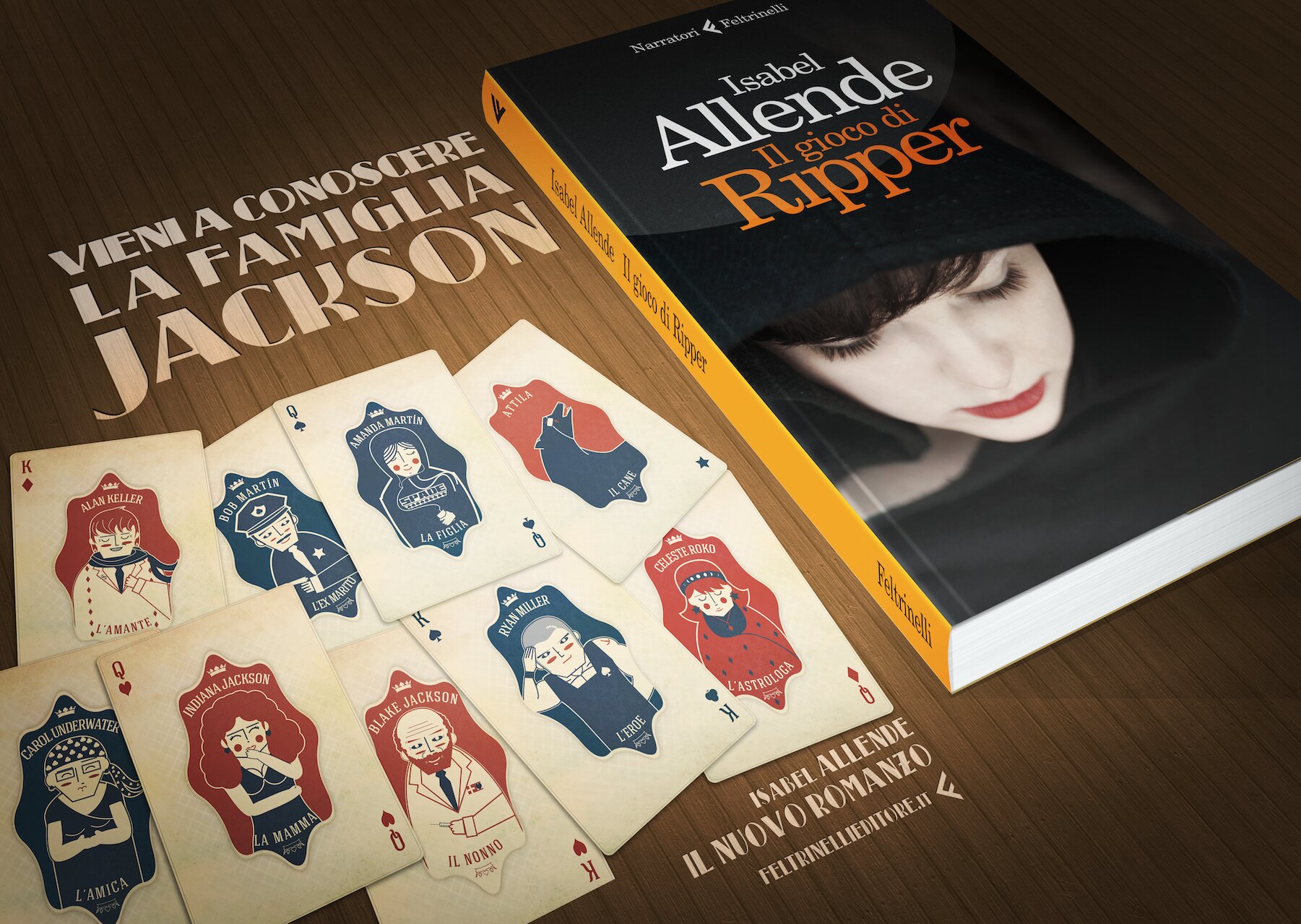
I’d done practically everything, from the idea to the execution. A one-man show, a way of working that would crop up again at other points in my career.
Toward the end of the project, though, I began to struggle.
The stylus for my graphics tablet seemed to be slipping out of my hands. Just opening Illustrator had become an effort. I think you can even see that exhaustion in the linework on the cards: the last character I drew was the dog, and honestly, it’s the weakest of the bunch.
This time, I didn’t need a white lock of hair.
I noticed something was wrong.
I was burned out. Again.
I delivered anyway.
That’s an important detail: the finished work can do a very good job of hiding what happened to the person who made it. From the outside, all anyone saw was a finished campaign.
Then the bill came due.
The Christmas break wasn’t enough. For weeks, my head was completely foggy.
And it wasn’t just work. For a few months, I couldn’t even get an erection. I’m writing this because when I say I wasn’t functioning the way I used to, this is exactly what I mean: that exhaustion had taken pieces of my life.
Recovery took a long time.
This time, I understood that I couldn’t just get back to it and pretend nothing had happened.
Learning to Stop
I’ve talked a lot about these episodes with my psychotherapist, and I’ll probably return to them when I write about my neurodivergence.
So I had to learn to set boundaries for myself.
A sprint needs an end decided before you start. And stopping has to be an option even if the work isn’t finished. Otherwise, the limit keeps moving along with the finish line.
Basically, you can go Super Saiyan 3 when you need to. You don’t do it to go grocery shopping.
The Exchange Isn’t Equivalent
I’m not telling you all this to say there’s never a reason to put in long hours.
I still believe in sprints. There are exams, projects, jobs, things worth believing in and putting serious effort into.
But knowing what I’m running for isn’t enough: I also need to know when to stop.
My thesis went well. The Allende campaign is still one of the projects I’m proudest of.
But neither was worth what I put on the line.
Like those anime techniques where the protagonist sacrifices years of their life to become incredibly powerful for a few minutes.
Except I wasn’t trying to save the planet.
I had to finish a website and draw a dog.
I keep seeing overwork glorified, especially on LinkedIn, with constantly pushing past your limits presented as a virtue. The problem is that those limits exist even when we manage to ignore them.
To borrow from the Elric brothers, the exchange wasn’t equivalent.
So go ahead and do that sprint, if you can afford it.
But the option to stop, your safety net, has to be part of the project from the very beginning.
It can’t be the reward you give yourself after you’ve finished.
Comments
No comments yet.
All posts